
I was talking with my siblings in our kitchen, and somehow we ended up thinking very deeply about the meaning of life, the essence of life.

Translation...
food lol.

And it came from the fact that we all grew up on the island, and coming here felt so different because here they have something called "fast food."

So we started asking a serious question:
Do we actually have fast food in Haitian culture?

And strangely enough, no one could answer.

Just crickets.

Seconds passed.
Minutes passed.

And I know it sounds like a simple yes or no question, but the more we talked about it, the more complicated the conversation became.

Some argued that if something is truly quick to make, then no, we don't have fast food. Others said if anything deep fried counts as fast food, then yes, maybe we do.

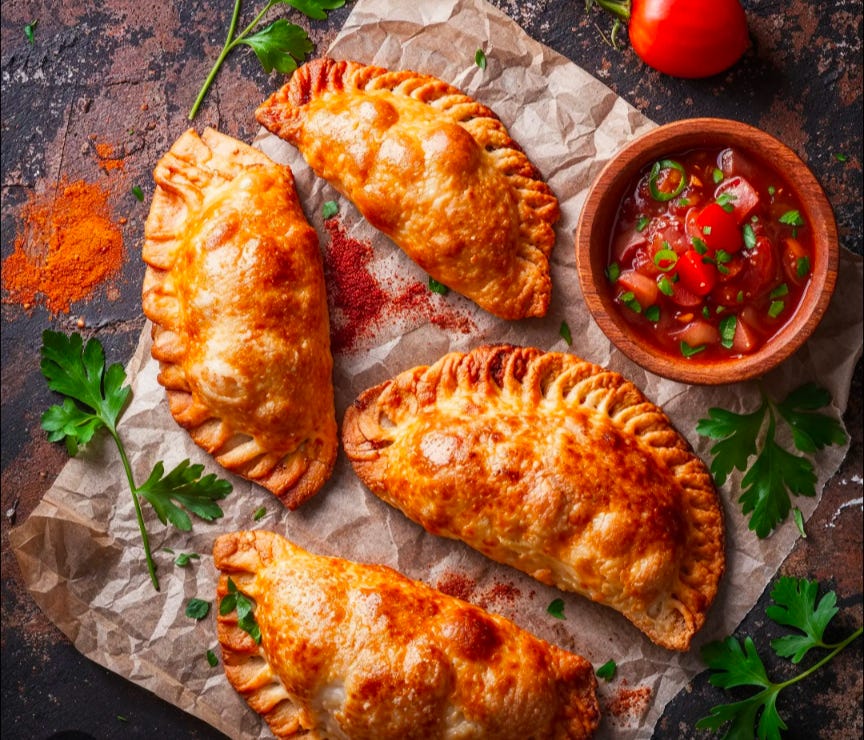
Then someone brought up pâté kòde.

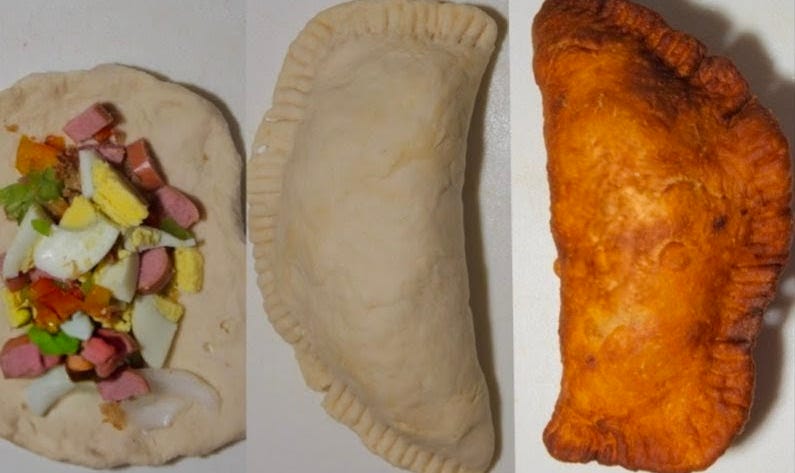
And honestly, the conversation got even messier. Because pâté kòde is not exactly quick to make. The dough itself is ideally prepared overnight so the pâté can be soft and delicate.

Then the smoked herring filling alone takes hours to make. You slowly build the sizzling layers with oil, garlic, parsley, green onions, and finally the herring itself.

And if you want peppers, you can add bell peppers and hot peppers too.

But after all of that, you still have to dice the hotdogs, boil the eggs, and let everything cool.
Because if you don't, the dough will melt you'll have a volcano in hot oil... a recipe for disaster or a serious burn.

Then finally put everything inside the dough before deep frying the pâté.
So by this point, I know it sounds like... that's a lot of work. I totally agree with you, my friend. It is.

But why are we still talking about pâté?

Well, there's something very interesting about preparing filling portions for the dough. Because in most Haitian households, we don't really measure things. Till this day, I genuinely don't know why.

My best guess is it’s something that gets passed down through generations lol.

So we almost always end up run out of filling. And that means not every pâté comes out identical.
Some might be missing hotdogs.
Some might not have egg.
Some might barely have enough filling at all.

And strangely enough, that is where character gets tested.

Because after the pâté kòde is done, prepared, fried, and passed around, somebody eventually realizes they received one with all three fillings inside.

And somebody else did not.

And the real question becomes:
Will the person who received more share something they never earned in the first place?
And I've been thinking lately...
isn't forgiveness like that?

Something interesting about forgiveness in the The Lord's Prayer is that it says, “forgive us our trespasses as we forgive those who trespass against us.”

And for a long time I used to read that almost transactionally, like I forgave someone, so God You owe me and forgive me too. But is that picture really the whole thing?

Because to say that would also mean that forgiveness is somehow something we earn.

But forgiveness is not earned.
Forgiveness is a gift.
Forgiveness is overflow.

When we realize the amount of mercy we have received from our Father, completely undeserved and fully given by grace, forgiveness starts overflowing into every area of our lives.

I started realizing that forgiveness toward others is evidence that mercy has already begun transforming us.

I know this enters interpretation territory, and I may be completely wrong. But I cannot help but notice something interesting about the word “as” in the prayer itself. The “as” almost feels like mirroring language.

Maybe it's not that fear of God withholding forgiveness becomes our motivation (before) to forgive.  And at the same time, this is not to take lightly the real warning Jesus shares in Matthew as a consequence (after) if we don't forgive our neighbors.

[For if you forgive others their trespasses, your heavenly Father will also forgive you, but if you do not forgive others their trespasses, neither will your Father forgive your trespasses.
(Matthew 6:14-15)]

Like a child can choose to obey out of fear and another child can choose to do so out of love. They both do the same thing, but only one of them gets a new heart that mirrors their Father's.

Maybe the prayer is already expecting forgiven people to become forgiving people. And that is why I keep thinking about pâté kòde lately. Because somebody eventually gets all three fillings inside. Another does not.

The strange thing is that nobody really earned it. The fillings were not distributed based on who deserved more. And the real question was always what happened next.

Would the person who received more hold onto it tightly?
Or would they tear the pâté in half and share something they never earned in the first place?

I think forgiveness works the same way. Because when we truly realize the mercy we have received from God, mercy we did not earn, something begins changing inside of us.

Forgiveness becomes overflow.

The overflow of people who realize they were first loved deeply, forgiven freely, and {filled} completely by grace.

And maybe forgiven people begin forgiving people the same way someone in a kitchen shares the pâté they never earned in the first place.
Heart Call:
The Lord's prayers is amazing. And also when we pray search our hearts He always speaks and expose every corner, my friend.
Forgiveness is mirroring our Father's heart.
Matthew 6:9-10, 12 AMP
[9] “Pray, then, in this way: ‘Our Father, who is in heaven, Hallowed be Your name. [Luke 11:2-4]
[10] ‘Your kingdom come, Your will be done On earth as it is in heaven.
[11] ‘Give us this day our daily bread.
[12] ‘And forgive us our debts, as we have forgiven our debtors [letting go of both the wrong and the resentment].
Prayer for your heart
Lord, search my heart and test my thoughts. Lead me to love and be quick to forgive like You Father always.
xoxo,
Lynn :)
Photo Credits: Mika’s Table.